Showing posts with label oscars. Show all posts

Saturday, December 18, 2021

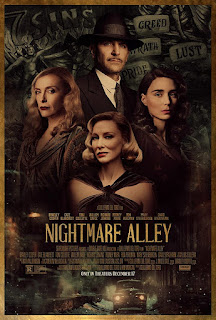
Nightmare Alley (2021): Movie Review

Directed by
Guillermo del Toro

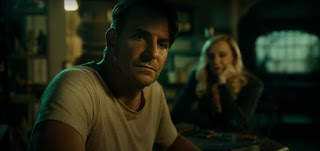
Nightmare Alley is a slow burn that, like one of Stanton Carlisle's shows, sets you up for a finale that takes your breath away and makes everything else worth it.

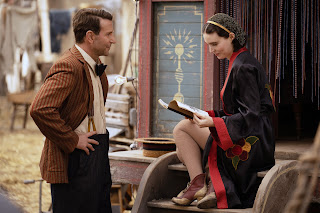
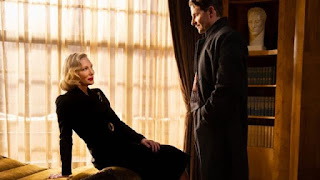
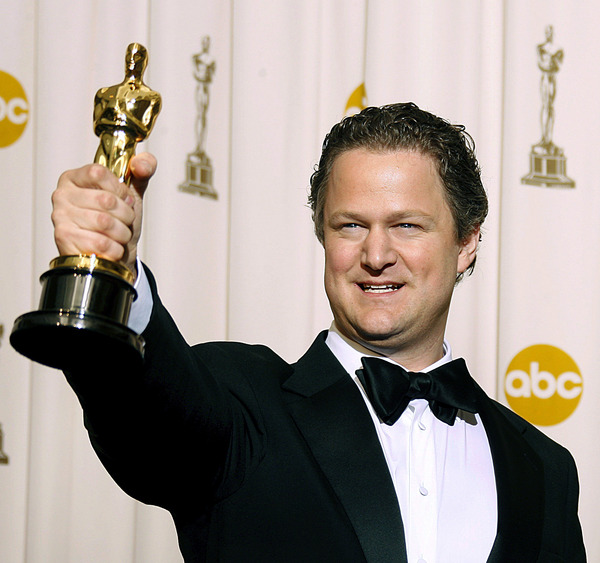
Based on a book that was already adapted into a classic film of the 1940's, Nightmare Alley is Guillermo del Toro's first directorial effort since his Oscar-winning efforts in The Shape of Water.  It tells the story of Stanton Carlisle, played by Bradley Cooper, who appears to have a questionable past when we meet him.  He stumbles upon a circus and finds a home among the illusionists and freak shows.  While there, he befriends a mentalist (David Strathairn) and fortune teller (Toni Collette) and begins to learn the tricks of their trades.  As Carlisle becomes confident in his abilities, he steps out on his own and starts his own show, however a partnership with a psychiatrist (Cate Blanchett) leads him to possibly push his skills and abilities passed what he can handle.

This is probably Guillermo del Toro's most grounded film, as all the fantastical here is illusion.  It is a beautiful film, with great cinematography by Dan Laustsen.  The direction and visuals set the scene for the actors to give masterful performances, led by Bradley Cooper.  This is one of Cooper's best performances in awhile, and he draws you in as he discovers and becomes part of this wild world.  The rest of the star-studded cast are brilliant as well, from Rooney Mara to Willem Dafoe to Ron Perlman to Richard Jenkins to Clifton Collins Jr. to Tim Blake Nelson.  The standouts in the supporting group are definitely Strathairn, Collette, and Blanchett though.  All these performances draw you into the story and instantly have you invested.

The script and story definitely take awhile to get going.  It earns its 150 minute runtime by really taking its time setting the scene and the world this film is creating.  For the first hour or so, I was wondering where the movie was going and when the action was going to pick up.  It definitely gets more intriguing once it leaves the circus, but you can tell everything is building up for the final act.

Nightmare Alley was going to be made or broken by if it could deliver on the climactic ending.  A film like Christopher Nolan's The Prestige failed in not having the payoff it needed.  A film like Ridley Scott's Matchstick Men succeeded because of how it stuck the landing.  Luckily, the last 30 minutes are some of the best filmmaking, acting, and scenes of the entire year.  You are waiting the whole time for something to happen, but when it finally does, it still manages to shock no matter how inevitable it seemed.  My jaw was dropped as I saw each twist and turn leading to a final scene and final shot I could see coming, but that doesn't change how haunting it is.  It nailed the ending in a way only the instant classics do.

The more and more I think about this film, the more I think it is one of the best of the year.  At its worst, it is engaging and intriguing.  At its best, it's as good as film gets.  Some of the best actors in the world are showing why they have that reputation, led by Bradley Cooper.  Then there's Guillermo del Toro, who once again brings to life a story with classic themes in a way only he can.

Rating: 4 stars


Watch the trailer here:

Saturday, November 6, 2021

Movie Review: Spencer (2021)

Directed by
Pablo Larrain

Every now and then, there is a portrayal of a real-life character that is so immersive and transcendent that it becomes impossible to separate the fact from the fiction; the person from the actor.  Philip Seymour Hoffman in Capote and Daniel Day-Lewis in Lincoln are two prime examples of this so far in the 21st century.  Kristen Stewart in Spencer belongs in that category of brilliance.

As stated at the start, Spencer is a "Fable based on a true tragedy" brought to us by director Pablo Larrain, most known thus far for bringing us a similar female biopic 5 years ago in Jackie.  Just like his last profile, Spencer is also featuring one of the most prominent women of the last century in a moment of crisis.  Unlike Jackie, this new film features specific events that are nowhere near as public.  Kristen Stewart portrays Princess Diana as she spends three days with the royal family over Christmas at the Sandringham estate in Norfolk, England.  During these three days, she is fighting against tradition, expectations, a toxic marriage, and a prying public eye.  The is starting to affect her both mentally and physically, as she seems to constantly be on the verge of a breakdown while also fighting body image issues and an eating disorder.  Timothy Spall plays Major Alistar Gregory, a former soldier hired by the queen for "security" from the paparazzi, but seems more interested in making sure Diana stays in line.  The only characters that appear to be concerned for her are the head chef Darren (Sean Harris) and personal dresser Maggie (Sally Hawkins).  She only feels like herself when she is able to spend time with her two young boys, William and Harry.

The vibe of this film is not quite what you may expect.  It is very quiet, meditative, and introspective.  Not a lot happens in this film as you simply get an opportunity to experience life through the eyes of this very public and complicated woman.  With that said, Spencer finds a way to be engaging in almost a hypnotic way.  This is thanks to two things: Larrain's masterful direction and Stewart's monumental performance.  By prominently featuring the scenery and many long, uncut takes, Spencer at times feels like a relative of Gus Van Sant's death trilogy of the early 2000's (Gerry, Elephant, Last Days), especially when you consider Larrain's recent announcement that he plans to complete this trilogy of his with Jackie and Spencer being the first two installments.  The comparison works best with Last Days as you have the profile of a secluded, tragic character.  However, where Van Sant's profile of Kurt Cobain failed, Larrain's profile of Princess Diana hits on almost every level.

Then there is Kristen Stewart.  Never has she disappeared more into role.  I think her performance is heightened to another level when you see some of the parallels between the Diana story being told and her own personal story of fighting norms and what people expect of her.  Those that pay attention know Kristen Stewart is a good actress, but those that don't still see her as the moody Twilight teen.  Much like her Twilight costar Robert Pattinson, Stewart has had to rebuild her credibility and reputation through small, independent films like Clouds of Sils Maria and Personal Shopper.  Now she is ready to show the world how talented she really is, and what a talent she shows!  She is not one you think of as an obvious choice for the Princess of Wales, but now I can't think of anyone else.

More than just a showcase for Stewart, Spencer is a brilliantly crafted film featuring a tale of one of the most tragic figures and stories of our time.

Rating: 4 stars


Saturday, September 25, 2021

Movie Review: The Alpinist (2021)

Directed by
Peter Mortimer & Nick Rosen

Three years ago, we were all captivated by a wild story about Alex Honnold, a rock climber whose attempt to free solo (individual climb without a rope) El Capitan in Yosemite National Park was chronicled in the Oscar winning documentary Free Solo.  It was nerve-racking yet inspirational to see the lengths people are willing to push themselves.  So when a film begins with an interview of Honnold talking about how he thinks someone is insane for the climbs he attempts, you know you are in for a crazy ride.

The Alpinist tells the story of Marc-Andre Leclerc, a 23 year old Canadian climber who spends his days soloing not only on rocks like Alex Honnold, but also through the mountains and across ice.  This relative unknown seemed to be more legend than anything when the documentarians found him.  That is because, unlike Honnold who often climbs purely for the competition, Leclerc climbs for the journey, the adventure, and the freedom of the solitude.  The film crew follows Marc, along with his girlfriend Brette, over a two year period from mountain to mountain, challenge to challenge ... at least when Marc allows them to.  Some climbs he escapes from his filmmakers to perform simply because a solo isn't a solo if someone is tracking him, even if it is just from a camera.

Leclerc is a fascinating character to follow.  Climbing is a sport that is continuing to gain in popularity.  We just saw it become an Olympic event this summer in Tokyo.  Add that to the fame brought to Alex Honnold and the sport in general through Free Solo, and climbing has become quite a trending activity.  This is what makes Marc fascinating.  He doesn't want the fame, he doesn't want the notoriety, he doesn't want the competition.  He just want to climb.  At one point, he accidentally breaks a speed record of Alex Honnold.  Honnold immediately returns to the rock and reclaims his record.  Marc never tried again because the record wasn't a good enough reason to climb.  He instead is constantly looking for the next new challenge simply to entertain himself.  It's such a rare quality to be so good and care so little that anyone knows.

It's impossible to watch this movie and not compare it to Free Solo.  It invites those comparisons by having Alex Honnold be the first voice you hear talking about Marc-Andre Leclerc.  So let's compare.  Both films are beautifully shot.  The settings make it easy to make a pretty film, but they both definitely capture the visuals well.  I might give an edge to The Alpinist in its direction.  They find ways to get some incredible shots and angles of the climbing, and with Leclerc climbing all over the world, it provides a much more varied landscape than the single-minded Free Solo.  With that said, what makes The Alpinist more interesting visually makes it less interesting narratively.  One of the things that makes Free Solo so special is the focus of the story.  One man, one rock, one challenge ... go.  On the other side, what makes Marc-Andre Leclerc a unique character hurts the film in building drama.  He moves so quickly from challenge to challenge that it removes so of the drama you see in Free Solo.  Also, Leclerc's tendency to need the solitude also forces the filmmakers to lose a level of drama that you gain from the open book that is Alex Honnold.  One difference that sets The Alpinist apart is the ending, which has a very different vibe than Free Solo.

With all this said, The Alpinist is a an incredible documentary that is worth a view, especially on the big screen.  Marc-Andre Leclerc is a dynamic personality that is magnified by the fact that fame makes him so uncomfortable.  In terms of the inevitable comparison, I would say Free Solo is the better film thanks to the focus of its narrative and that it is what introduced so many of us to the sport.  With that said, The Alpinist is an incredible companion piece focusing on a very different, but just as intriguing solo climber.

Rating: 3.5 stars

Monday, February 29, 2016

Reaction to the 2015 Academy Awards: Was "Spotlight" the Most Shocking Win of the Last 25 Years?


            The 2015 Academy Awards put the “guilt” back in guilty pleasure.  If Chris Rock didn’t make you feel ashamed for watching a broadcast (and supporting an industry) which actively promotes discrimination and racism, then Lady Gaga made you feel bad for turning a blind eye to the epidemic of rape on college campuses.  If Leo didn’t make you feel bad for polluting our planet, then Sam Smith made you feel bad for following a ceremony that had never previously awarded an openly gay recipient (never mind the historical accuracy of that claim).
            Then there were the moments when you really should have felt bad: Alexandro G. Inarritu, the first director to win back-to-back Oscars since the Truman Administration, giving what was clearly the night’s most impassioned and sincere speech, void of any vanity or insincerity . . . only to be abruptly cut off by Wagner’s “March of the Valkyries” (Wagner, Max!).  By contrast, Lady Gaga got a warm introduction from her “friend” Vice-President Biden, and five minutes for a song that didn’t even win.  Does anyone even remember the name of the film her song was from?  But I suppose it could be worse; you could have been one of the two Song nominees (“Manta Ray” or “Simple Song #3”) that wasn’t even invited to perform onstage.  It felt reminiscent of Rock’s witty joke about sorority racism – “we like you, but not that much.”
            And then there’s the moment that everyone is (or should be) talking about: Stacey Dash.  If you had Stacey Dash on your betting slip for person most likely to be talked about after the Oscars, congratulations and I would like to borrow some of your millions.  In keeping with the passive aggressive spirit of this year’s awards, many have said that if you didn’t understand the Stacey Dash joke, it’s because you’re an ignorant opponent of #BlackLivesMatter.  My response is that I didn’t understand the joke because Stacey Dash actually is an ignorant opponent of #BlackLivesMatter.  In theory, it may be funny to suggest that she could serve as a director of minority outreach – but when Dash actually strutted on stage and gave a diabolical laugh like Elle Driver in Kill Bill, the joke became uncomfortable confusion.  Was she satirizing herself?  Was she in on the joke, making the audience feel like dupes?  At a time which Donald Trump’s parody of himself is one of the two people that will be elected President, uncomfortable self-reflexive meta humor has become the norm.

*shrugs*

            Finally, there was the thing that no one really talked or cared about: the movies themselves, crudely disregarded by the Compton audiences polled on the street by Chris Rock in a sketch which somehow managed to feel mean-spirited toward both black lives as well as the nominated films.  Mad Max set some kind of record by winning six Oscars in the first 75 minutes of the broadcast, while the colorful acceptance speeches went a long way in further cementing the unlikely diplomatic ties between Australia and Namibia. Then, a series of surprising upsets woke up the few audience members who actually cared about the identities of the recipients: First, the Mad Max: Fury Road train was abruptly halted when Ex Machina upset it in the category of Visual Effects (eliminating the chance of anyone filling out a perfect Oscar ballot).  Then, Oscar voters decided that Creed wasn’t a serious enough film and gave Best Supporting Actor to Mark Rylance as the avuncular, friendly, cute old Soviet spy onscreen for ten minutes in Bridge of Spies.  Finally, Lady Gaga didn’t get another platform to talk for five minutes about giving consent when the unmemorable song from Spectre upset it.
            The rest of the night followed in predictable fashion: Inarritu’s small fraction of a speech, Brie Larson, Leo, and Morgan Freeman announcing that The Revenant had taken Best Picture.  Just like we all thought it would.  Except, OH WAIT.  Out of nowhere, Spotlight – a film which had only won one prior award, a film with no special effects, historical backdrop or over-the-top acting, a film grossing under $40 million and produced by Open Road – was the name read by a stunned Freeman.  Huh?  Going into the night, Spotlight certainly had a shot of winning Best Picture . . . but The Big Short was the film fresh off key wins in award season, Mad Max was the film that was dominating the evening, and The Revenant was the heavy overall favorite. 
            Needless to say, I, along with everyone else (except Terry), was in complete shock.  Nothing in the evening had prepared anyone for Spotlight taking the top prize; Mark Ruffalo had lost to Mark Rylance, Rachel McAdams had lost to Alicia Vikander-Saltz, Tom McCarthy had lost to Inarritu, and Spotlight failed to pick up Best Editing (which in the last few decades has become a key predictor of Best Picture).  I believe that Spotlight was the right choice, although Mad Max and The Revenant were excellent films in their own right.  But it didn’t win the Golden Globe, the Director’s Guild, the Producer’s Guild, or the BAFTA. 
            The only question left to ask: How shocking was Spotlight’s win?  I’ve been watching the Oscars the last two decades and have seen plenty of upsets.  So let’s break down Spotlight’s Best Picture win in the context of the biggest Oscar upsets of the last 25 years:


10. 1999 Best Actress: Hilary Swank over Annette Bening
Perhaps it’s not as shocking in retrospect, but it’s worth remembering that American Beauty was the overwhelming favorite in 1999 and for the most part, it absolutely delivered on awards night.  Bening was a high-profile actress who, by all accounts, did the best work of her career.  Swank was an unknown whose film (Boys Don’t Cry) was made for $2 million and almost wasn’t released.  Furthermore, while American Beauty was an uplifting, polished and constantly witty throughout, Boys Don’t Cry was a stark, depressing true story set in a Nebraska trailer park and released in a time when honest depictions of LGBT issues were taboo.  Most critics knew that Swank was the more deserving choice, but they had said the same thing about Emily Watson in 1996, Linda Fiorentino in 1994, and Ellen Burstyn the next year in 2000.  In other words, the critic’s favorite is usually not the winner at the Oscars.  But Swank’s win was a rare bucking in the trend.


9. 2006 Best Foreign Film: The Lives of Others over Pan’s Labyrinth
Foreign Film isn’t exactly the sexiest of categories, and is in fact often really difficult to predict, but Pan’s Labyrinth appeared to be the clear favorite in 2006.  It was made by a director who was well-known in the United States (Guillermo Del Toro); it had already won three awards for the evening, and was even nominated for its screenplay; it was a huge hit with critics (see this if you don’t believe me) and fans loved its mixture of lowbrow fantasy and highbrow historical and cultural memory.  If it had a “lock” on any category, it was Best Foreign Language Film; but out of nowhere, it was upset by The Lives of Others, a little-known film not yet released in America.  Furthermore, it was a German historical drama that wasn’t about the Holocaust.  I mean, look at Cate Blanchett’s reaction when she reads the envelope – it is total and complete shock.  Today, the award makes a little more sense; The Lives of Others turned out to be just as great as Pan’s Labyrinth.  For those who really pay attention to the Oscars, this upset should perhaps rank higher, but again, Foreign Film is a relatively obscure category where upsets aren’t too uncommon or significant.


8. 2002 Best Actor and Director: Adrien Brody over Daniel Day-Lewis, Nicolas Cage, Jack Nicholson, and Michael Caine; Roman Polanski over Rob Marshall.
Yes, I’m cheating a little here but very few people predicted The Pianist to perform as well as it did in the major awards.  Best Actor was wide open, with Day-Lewis as perhaps the slight favorite (in Gangs of New York), so perhaps Brody winning was not so much of an upset as much as it was a surprise that he beat the other four actors, each of whom was a towering previous winner.  Polanski was a major shock.  It’s important to remember that Chicago was a Miramax-backed spectacle in an era right after Moulin Rouge when musicals were hot again.  It was nominated for 13 Oscars.  The Pianist was financed in Europe, featured an unknown lead actor, and was released in the United States the last week of December.  The only reason it wasn’t a bigger shock?  Polanski was long overdue for an Oscar (with his scandalous past a distant memory for many voters) and most everyone knew that The Pianist was a better film than Chicago.  But ultimately, the voters chose to award style over substance. 


7. 2001 Best Actor: Denzel Washington over Russell Crowe
A little like Annette Bening losing to Hilary Swank, except Crowe seemed like even more of a shoo-in than Bening.  Coming off a rather undeserving victory the year before for Gladiator, winning Best Actor for the second consecutive year would cement his legacy as the best performer working in Hollywood.  Furthermore, his performance in A Beautiful Mind was spellbinding; he’s in 95% of the movie and is unquestionably the biggest reason why the film ultimately won Best Picture.  But an ugly little thing called “Oscar politics” began to sneak into the race in January 2002; Crowe received negative publicity for his gruff attitude and unfriendly family image.  It didn’t help that A Beautiful Mind got some backlash for deceptively cleaning up the life of an adulterer and communist sympathizer.  Enter the all-American Denzel Washington, whose performance in Training Day gave no bones about him being a villain.  Training Day had just enough 30-second clips of Washington screaming to satisfy Oscar voters and in a stunning and unjust upset, one of the best performances of the decade was denied an Oscar victory. And nothing against Washington, who is of course a great actor, but Training Day set the benchmark for better performances of his after 2001. 


6. 1993 Best Supporting Actress: Anna Paquin over Rosie Perez and Winona Rider
Like 2002 Best Actor, this race was as wide open as any in Oscar history.  Perez and Rider were mostly the favorites, since they were well-known young actresses who were on the brink of major stardom.  Both Fearless and The Age of Innocence were high-profile, well-reviewed films.  The Piano had received more nominations than either film, but Paquin was an unknown first-time performer from New Zealand and was only 11 years old.  Her win is generally considered one of the most shocking in Oscar history, but it’s worth remembering that The Piano performed very well at the 1993 Oscars (with additional wins for Best Actress and Original Screenplay).  Additionally, Paquin had more screen time in The Piano than anyone else in both her film and her category, and although Supporting Actress was wide open in 1993, none of the performances were that memorable except Paquin’s.  It’s always shocking when the Academy honors someone that young, but in this circumstance, the stars aligned perfectly to enable one of the more memorable and entertaining of recent Oscar upsets.


5. 1996 Best Supporting Actress: Juliette Binoche over Lauren Bacall.
This is the first thing that pops in many people’s minds when the words “Oscar upset” are uttered.  Let’s run down a few reasons why it wasn’t really all that shocking, albeit with the luxury of hindsight.  First, Binoche’s film (The English Patient) was the overwhelming favorite at the 1996 Oscars, and ended the evening with nine wins.  It was a historical drama based on a best-selling book that had been praised by critics and audiences all around the world.  Bacall’s film (The Mirror Has Two Faces) was a minor romantic comedy (minor even by Barbra Streisand’s standards) which got mixed responses from critics and received only one other nomination, for Best Song.  Binoche’s role was a pivotal one in the story, while Bacall’s role was mostly for the purposes of bitchy one-liners and perfectly-timed comebacks.  The English Patient was produced by the Weinsteins, while Barbra Streisand’s films had always been well-documented for their repeated failure to receive considerable Academy Award attention (justified or not).  Still, it seemed apparent to everyone in the room that night that Bacall would win what was generally tantamount to a lifetime achievement award; instead, the Academy honored Binoche, a well-known actress in the European art house circuit and someone who wasn’t exactly tough to stare at either.


4. 2006 Best Supporting Actor: Alan Arkin over Eddie Murphy
This was a shocker.  Dreamgirls was Eddie Murphy’s triumphant comeback, a perfect blend of comedic timing and powerful onscreen presence.  The film was well-received (although not overwhelmingly so), but perhaps even more importantly, it was heralded as a breakthrough – the first film to receive considerable award attention with an all-black cast.  It was also a musical made in the heyday of the Moulin Rouge/Chicago musical resurgence.  It was shocking when Dreamgirls didn’t receive a Best Picture nomination, but the prevailing logic was that acting awards for Murphy and Jennifer Hudson – each of who won practically everything during award season – would compensate.  Instead, Hudson won while Murphy lost to Arkin’s rather vulgar and embarrassing turn as the dirty grandpa in Little Miss Sunshine.  Maybe Oscar voters didn’t like that the February 2007 ceremony coincided with the theatrical release of Murphy’s follow-up to Dreamgirls, the abominable Norbit.  Maybe the writing was on the wall for Dreamgirls when it failed to secure a Best Picture nomination.  Maybe they just liked the sight of Arkin swearing.  Whatever the case, this was an inexplicable and surprising outcome.


3. 2005 Best Picture: Crash over Brokeback Mountain
The 2005 Academy Awards ended like the infamous Seahawks-Packers “Fail Mary” game: It was extremely controversial and everyone had an opinion about it, one way or another.  Looking back on it today, the consensus is that it was a poor decision by the Academy – Crash is remembered as a TV-like diatribe on race relations, with poorly-developed characters getting involved in obvious situations resolved by an overly simplistic liberal message.  Meanwhile, Brokeback is revered as the great love story of this generation, with the second-best performance from the most tragic actor of this generation (Heath Ledger).  Not awarding it Best Picture was just another example of homophobia destroying what is pure and true in the world.  The reality, however, is different and somewhere in the middle.  Both are good films, with Crash slightly underrated and Brokeback slightly overrated as a result of the Academy’s vote.  It was genuinely surprising – especially considering that Crash was a low-budget film with no A-list talent that had been released in March and had received virtually no prior awards – but critics like Roger Ebert championed it, and the film had momentum heading into the night.  There was no single dominant film that year (Crash and Brokeback won three Oscars each, tied for the most).  But judging by Jack Nicholson’s timeless expression, a win for Crash was unexpected to say the least.


2. 1998 Best Actor: Roberto Benigni over Tom Hanks, Edward Norton, Ian McKellan, and Nick Nolte.
Here’s the category everyone forgets.  Even when people remember the 1998 Oscars, they tend to only remember one thing – Shakespeare in Love upsetting Saving Private Ryan.  I didn’t even include that on this list because (A) Shakespeare in Love was backed by Miramax, (B) It had more nominations and wins than Saving Private Ryan, and (C) Saving Private Ryan was released in July while Shakespeare was released in December. No, the great surprise of 1998 was Roberto Benigni beating the likes of Tom Hanks, Edward Norton, Ian McKellan, and Nick Nolte.  It remains the only time a non-English-speaking role won Best Actor.  So what happened?  Nolte was overshadowed in his own film (Affliction) by James Coburn, who won Best Supporting Actor; McKellan’s film (Gods and Monsters) was too small; Norton’s film (American History X) was too violent and threatening for conservative Oscar voters; and Hanks was overshadowed by the visual effects spectacle of Private Ryan.  In addition, there were a handful of Best Actor snubs, the most notable of which were Jim Carrey (The Truman Show), John Travolta (Primary Colors) and Warren Beatty (Bulworth).  I suppose this meant that the race was up in the air, and even though Life is Beautiful was a hit with audiences and critics as well as a Best Picture nominee, Benigni’s performance was rarely mentioned.  On top of that, Best Actor is typically the least conducive category to comedic roles.  My theory about this race is that if today’s voters decided the outcome, Norton would be the winner.  But at the time, American History X was considered too low-budget, too grisly, too in-your-face.  Norton played a profoundly unlikeable character and the movie barely grossed $20 million.  But both at the time, as well as in this very moment today, it has to be considered the most shocking upset in Oscar history, until . . .


1. 2015 Best Picture: Spotlight over The Revenant, Mad Max and The Big Short
Spotlight didn’t come out of the blue like Benigni, Paquin, or Arkin.  In fact, it was the front-runner for Best Picture for at least a month or two and had all the chops to back it up: Great reviews, depicting not just one but two Important Topics (the Catholic clergy sex abuse scandal as well as the collapse of investigative journalism), A-list cast, a shoo-in for Original Screenplay.  But once the 2016 award circuit commenced, it was clear that Spotlight had serious shortcomings as a Best Picture contender.  Tom McCarthy was not an A-list director (and he was coming off The Cobbler); it was a quiet, talky film with no explosions, sex scenes, or characters who scream (minus one oft-repeated award-bait moment); it was financed by a low-profile studio (Open Road) which couldn’t afford a major campaign blitz; and it became pretty clear that The Revenant and Mad Max would dominate most of awards.  Both it and The Big Short were in a similar third-place position heading into last night – topical films with a few big stars that were talky and probably wouldn’t win much.  Even with that said, The Big Short had Brad Pitt producing, portrayed a more recent Important Topic (the economic collapse), and won the most predictive of all pre-Oscar awards (the Producer’s Guild Award for Best Picture).

            So why did Spotlight prevail?  It may have to do with the relatively new balloting system installed by the Academy, a preferential system which benefits films with wide appeal over films which receive the most first-place ballots.  In other words, a film like The Revenant may have garnered considerable first-place votes, but it may have also turned off voters who didn’t like the violence or the somewhat preachy and superficial message about colonialism and encounters between settlers and natives. Mad Max surely got many first-place votes, but perhaps also as many lower-place votes as a result of being a summer action movie which was (technically) a sequel.  Both Spotlight and The Big Short had excellent reviews, and probably many 2nd and 3rd place votes.
            But it still doesn’t answer the question of why it beat The Big Short.  And did The Revenant truly contain more uncompromising or potentially divisive content than Inarritu’s previous film, the 2014 Best Picture winner Birdman?  Furthermore, Spotlight was having a poor showing for almost the entire night; it’s a wonder that its producers and cast hadn’t bailed out and preemptively exited for the after-parties.  Kenneth Turan wrote a good piece today which contends that of the three or four major Best Picture nominees, Spotlight was the most emotionally satisfying.  The economy is still in recovery, indigenous people (and the earth’s temperature) are still suffering, and summer action movies still have no place winning Best Picture.  But in Spotlight, Goliath (the Catholic church) was defeated by David (ragtag journalists) and at the end of the day, Academy voters prefer emotional uplift and a happy ending.  And although I enjoyed Spotlight thoroughly and would have gladly awarded it my first place vote, the shocking conclusion of the 2015 Academy Awards may go down as less Frank Capra and more M. Night Shyamalan.

            What were your thoughts?  Were there any other moments or awards that deserve attention? Let me know below! 

Monday, January 4, 2016

Year in Review: Zach's Top Ten Films of 2015


            Like the main character of my favorite film of this year, I became homesick for motion pictures in 2015.  In spite of the wealth of publications and breathless critics proclaiming the usurping of film by television (a claim that has been made on a regular basis since the 1940s), I still ardently believe, or am just too rigid to concede otherwise, that even the most pedestrian movies are still better than the best TV shows.  Yes, film may be a dying art (metaphorically as well as literally) and television may be in a “golden age” – whatever that means – but no television set, no matter how high-definition, can adequately replace the overwhelming totality of the theatergoing experience.  And for those who vigorously assert that a 13-episode season contains infinitely more complex narrative depth than even the most intricately written two-hour film, I would counter that most often in drama as in life (as well as with talkative guests at parties), less is more.
            Television remained a vast wasteland in 2015 (even in spite of a handful of watchable and engaging programs like Fargo, Better Call Saul and The Jinx), and while it is undeniable that many movies in 2015 might have been a wasteland too, at least their shorter running times enabled their experiences to be considerably less vast.  Of course, the most successful movies in 2015 were fundamentally derivative – sequels, franchises, remakes, rip-offs, or in some cases, all of the above – but let the populist audiences eat their cake.  At least films like Mad Max: Fury Road, Creed and Star Wars: The Force Awakens added much-needed diversity, youth, and an astute sense of political consciousness to their narratives rather than simply playing lazy old hat. 
            As for The Force Awakens, a film that outgrossed all six of its previous installments in the first week of its theatrical release: Say what you will about it (I personally enjoyed it more than I had ever expected to), but few can deny the powerful pull it had for young and old audiences alike, illustrating for better or for worse that commercial cinema still has that unique and inimitable ability to bring even the most disparate and dissimilar audiences together for the same cause.  Even the snarky cynical Marxist in me can take comfort in knowing that, in most cases, for a film to earn that much money (much of which derives from repeat viewings), it has to have some markers of quality.  Same with Jurassic World, Furious 7 and Spectre.  No one went to those movies because they were bad – people didn’t go to (or back to) Pan precisely because it was bad.  And the millions of Chinese audiences who saw Avengers: Age of Ultron and Hunger Games: Mockingjay Part II had no other choice. It is wrong to blame movie audiences for all the bad movies released and the gradual erosion of taste and critical insight into media and storytelling.  People are usually smart, and great movies are genius.  Instead, let’s blame television.

2015 by the numbers
Total 2015 films seen: 61
“Thumbs up” percentage: 63.9 percent
Movies I haven’t seen that could still potentially make this list: The Revenant, Son of Saul, The Lobster, Anomalisa, Mustang, Eden, 45 Years, Taxi, Jauja.
Movies I’m proud to say I didn’t see: Cinderella, The Good Dinosaur, The Intern, Pixels, Fantastic Four, The Age of Adaline.
Overrated: Room, Me and Earl and the Dying Girl (two of the year’s worst movies), What We Do In the Shadows, Bridge of Spies, Love and Mercy, Time Out of Mind, The Big Short, The Martian (It’s probably appropriately rated, but nowhere near deserving of Best Picture).
Underrated: The Walk, Dope, Unfriended, Boulevard, Paper Towns (not good, but so much better than Me and Earl…), Blackhat, the first 20 minutes of Fifty Shades of Grey, and yes, Star Wars: The Force Awakens (That’s for all the haters.)
Best Actor: Jason Segel, The End of the Tour
Best Actress: Saoirse Ronan, Brooklyn
Best Supporting Actor: Liev Schreiber, Spotlight
Best Supporting Actress: Alicia Vikander, Ex Machina

Honorable Mention


Carol (Todd Haynes)


Inside Out (Pete Docter)


It Follows (David Robert Mitchell) 


Mad Max: Fury Road (George Miller) 


Sicario (Denis Villeneuve) 


The Top Ten


10. The Hateful Eight (Quentin Tarantino) If it feels obligatory putting another Tarantino film in my top ten list for the year, it is because his films represent the best aspects of motion pictures in general.  He is a visionary auteur who self-consciously invokes his cinephilia both on-and-off the screen.  His films are uncompromising, lengthy, full of circular and quirky inimitable characters and dialogue, and full of images that are as violent as they are inherently, romantically cinematic.  The Hateful Eight is chalk full of Tarantino, from the setting (a self-reflexive western) to the actors (Samuel L. Jackson, Michael Madsen, and Tim Roth, among others) to the over-the-top levels of bloodshed in the film’s second half.  But even in spite of those recognizable components, the film still feels fresh and engaging, portraying characters we want to know more about, events that have greater significance than what we could possibly initially comprehend, and outrageous moments that no other director would have the audacity to remotely approach.  In interviews, Tarantino has discussed how, in spite of being confided to a single interior space over a single 24-hour period, the story of The Hateful Eight is really the story of reconciliation after the Civil War between the North and the South.  This reconciliation is anything but seamless and, as Tarantino’s recent activism has demonstrated, neither has it been fully resolved in 2015.  But the way it is depicted in The Hateful Eight – through a surprising degree of delicacy and thoughtfulness in the midst of vast bloodshed and dismembered body parts – is as idiosyncratic and improbable as its virtuosic filmmaker.


9. Tangerine (Sean Baker) One of those wonderful and woefully rare movies where, after the first ten minutes, it is safe to say you have no idea what you have gotten yourself into.  As I wrote in my initial full-length review, the story is something of a cross between Paul Haggis’ Crash and The Jerry Springer Show: Two transgendered hookers (Mya Taylor and Kitana Kiki Rodriguez) spend 24 hours before Christmas hanging out in a donut shop, confronting a cheating ex-boyfriend, performing music at a local bar, soliciting johns on Hollywood Boulevard, and enacting revenge on an adulteress.  The movie is simultaneously funny, vulgar, sweet, gritty, trashy, and even surprisingly touching.  It is also somewhat groundbreaking; director Baker shot the entire film on an iPhone 5s using nothing more than an anamorphic adapter blow up the images.  The result is a crisp, detailed production that looks in no way as though it was filmed using a consumer device.  The film is by no means a “message” picture, but it is difficult to believe that even the most skeptical and socially rigid audience member would not be won over by the charming and diverse cast.  Ultimately, Tangerine is not about sex as much as it is about being an outsider, and how vital it is to combat the loneliness and isolation that comes with the territory of not belonging, with other people you can put your trust in.  Of course, the film is much too fun and subversive to be caught up with anything approximating that preachy of a message, but deep down, Tangerine has its heart firmly in the right place.


8. Goodnight Mommy (Veronika Franz and Severin Fiala) After you see it, you will probably observe its narrative resemblance to certain other films and novels (which I dare not mention here), but for the most part, Goodnight Mommy is not concerned with plot – the film’s overwhelming concern is mood and atmosphere.  The story is told through the perspective of twin cherubic 10-year-old boys, Elias and Lukas (played by real-life brothers Elias and Lukas Schwarz), who inhabit an isolated house deep in the woods.  One day, a woman purporting to be their mother returns with bandages wrapped around her face after having undergone substantial facial reconstructive surgery (the first of two films on my list this year to involve a woman whose facial surgery brings her identity into question).  The boys quickly realize that the woman is not who she claims she is and they begin to craft ways of bringing their real mother back – the results of which become gradually more dark and twisted.  The film moves at a slow pace in the first half, only to move to a much more ominous, quick, and violent resolution in the second half; this strategy reveals itself as intentional at a certain point when revelations are revealed which call into question the reliability of some of the characters.  Like the best films of Michael Haneke and Lars von Trier, Goodnight Mommy contains a deep and unremittingly dark view of humanity, which in many respects is far more disturbing than any bloodshed depicted in the film.  It is the type of film that could never be made in the United States (or rather, if it was made, it would be more chopped up than Elias and Lukas’ mother’s face), and yet somehow after seeing it, your first impulse is to watch it again. 


7. The Walk (Robert Zemeckis) At this point, it is more than fair to call The Walk a box-office bomb (grossing only $10 million domestically, less money than The 33, Burnt, and The Gunman).  It has also been all but completely ignored by critics and end-of-year awards, which is rather inexplicable for a major studio film released in October to favorable reviews.  Maybe it was the PG rating, maybe it was Joseph Gordon-Levitt’s French accent (not bad at all in fact), or maybe everyone thought they already knew all about Phillippe Pettit’s incredible tightrope walk across the Twin Towers in 1974 after seeing the 2008 documentary Man on Wire.  Who knows.  In any event, Zemeckis’ film is a spectacular rendering of Pettit’s unconventional journey, first as a fearless street performer and amateur tightrope walker in Paris, then as an internationally-renown daredevil putting his life in danger for the sake of his art.  The story is a neat combination of Ocean’s Eleven and Hugo, and the supporting characters are interesting and serviceable, but the heart of The Walk is its incredible visual effects, which are truly heart-pounding and even stomach-inducing.  I must admit without hyperbole, my palms became unspeakably sweaty for most of the film’s final hour.  I suppose one must ask the same question that was asked of Avatar and Gravity, which is whether the IMAX 3D experience put a spectacular disguise on an otherwise pedestrian story.  But in this era where film and TV spectatorship has become disturbingly intertwined, The Walk serves a reminder that there is no other experience quite like an epic movie (on a movie theater screen) transporting you to a visual world few others have ever seen. 


6. The Lesson (Kristina Grozeva and Petar Valchanov) This was an excellent under-the-radar film from Bulgaria that no one saw because it only played in a handful of festivals at U.S. cities (fortunately, it is available to stream right now on Netflix).  The story: An English teacher named Nadya (Margita Gosheva) is on the verge of bankruptcy, cohabiting with an insolvent alcoholic husband and a young daughter.  The film profiles a few days in her life, as creditors are able to track her down and threaten to foreclose on her house unless she can come up with a substantial sum of money.  Aesthetically and narratively, the film bears an unmistakable similarity to Two Days, One Night, as Nadya scrambles desperately to solicit assistance from friends and family (as well as the occasional perfect stranger), all while steadfastly struggling to maintain her dignity in the face of surrendering to defeat and humiliation.  It’s not as good as the Dardenne Brothers’ masterpiece, but I enjoyed the way the film goes to great lengths to establish an elaborate geographical and emotional universe (albeit on a small scale) that seems to throw hurdle after hurdle at the likeable and engaging heroine.  The film moves at a very quick pace, is often quite unpredictable, and even contains a few scenes of wicked and unexpected humor (such as Nadya’s confrontation with her estranged father’s new trophy wife).  And Gosheva’s performance is one of the year’s best, illustrating the stark realities of a desperate teacher trying haplessly to honor the same ethical code she so rigidly instills to her students.
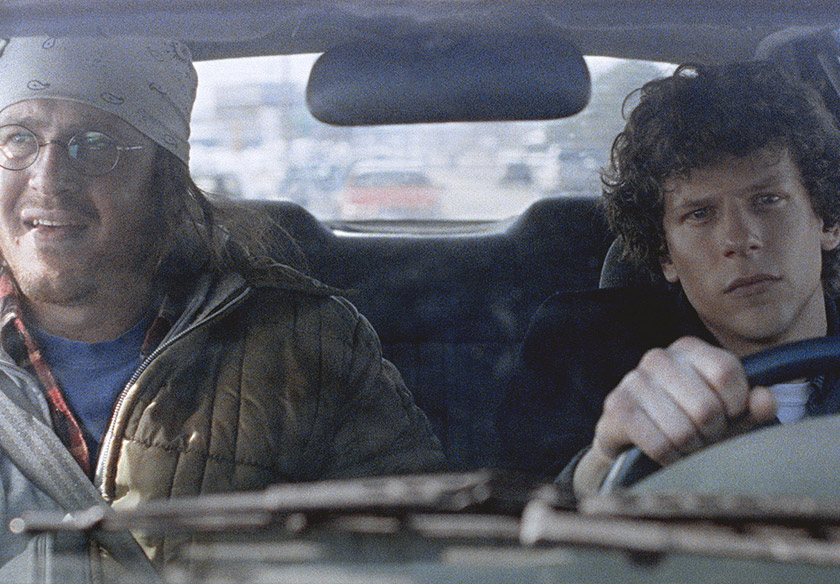

5. The End of the Tour (James Ponsoldt) From a purely subjective standpoint, there may have been no film more personally enjoyable to watch in 2015 than The End of the Tour, particularly in light of the considerable doubts I had walking into it.  Would the film lionize, demystify, or lampoon David Foster Wallace and his mythical literary status over the past two decades?  Would Ponsoldt dumb down Wallace’s complex and uncompromising personality, and how would his intellectual contributions be translated into a coherent narrative?  For all its audacity, the film finds its greatest success in how small it is, opting only to show a few days in Wallace’s life soon after the publication of Infinite Jest in 1996.  Not too far removed from Almost Famous, the film depicts a struggling young Rolling Stone writer named David Lipsky (Jesse Eisenberg) given unprecedented access to Wallace (Jason Segel) at the precipice of his launch into international stardom.  The vast majority of The End of the Tour is the long, rambling, often unresolved conversations between the two protagonists, which recalls the rich and beautifully unkempt attitudes of 1970s cinema (particularly Wim Wenders and Eric Rohmer).  Set against a backdrop of the snowy Midwest, Wallace is depicted as a relentlessly self-conscious and earnest burgeoning intellectual, and the film is daring in the way it doesn’t shy away from frequent unspoken tension and hostility between him and Lipsky.  Both performances are outstanding, but Segel in particular ascends to completely new levels of acting, using a beautifully understated demeanor to hint at deep levels of despair and loneliness.  In spite of everything you may think you know about Wallace – and everything you think you know about Wallace’s acolytes and imitators – the film shows something new with dialogue that feels substantive and meaningful, which has become rare for the majority of commercial cinema.  


4. Spotlight (Tom McCarthy) The current front-runner for Best Picture is well-deserving of the praise which has been bestowed on it.  It is a story that could have easily gotten swept up in the hysteria and revelations of the Catholic Church’s sex abuse scandal, as exposed by the Boston Globe’s Spotlight investigative reporting team in the early 2000s, but rather than being exploitative or overly political, the film wisely limits its purview solely to the perspectives of the journalists working on behalf of Spotlight.  Subsequently, the film isn’t really as much about the church abuse scandal as it is the contours and nuances of investigative journalism in the era just before the internet made access instantaneous and near-universal (and arguably rendering much previous investigative journalism benign and reactionary).  Like All the President’s Men, the film is singular in its focus on reconstructing events that occurred years earlier by characters we’re vaguely familiar with through name and verbal description only.  Even by the end of the film, we know considerably more about the much-ballyhooed classified church documents than we do about the personal lives of the reporters (played with uniformly strength by Michael Keaton, Mark Ruffalo, Rachel McAdams, and Brian d’Arcy James), which is precisely the point.  It would be a fallacy to praise the film on that one aspect alone, but it deserves recognition because McCarthy’s focus (as one of the film’s characters astutely points out) is not on the relatively inconsequential individuals involved, but the larger institutional systems that enabled and promoted years of abuse and cover-up.  The film also illuminates the power of ethical, painstakingly-researched journalism in a way that isn’t quite Frank Capra, but also isn’t cynical or jaded either.  Spotlight is quietly a David-and-Goliath story where the slingshot is replaced by the much more powerful mighty pen.


3. Ex Machina (Alex Garland) You may have heard that Ex Machina contains the best dance scene in recent cinematic memory (you would be correct).  It also is the best pure sci-fi film in an era when the notion of “sci-fi” has been relegated to mean bloated budgets, high-octane action with little attention to story, and superfluous special effects replacing intellectually probing questions about the future of human ingenuity.  In yet another remarkable performance in a truly prosing career, Oscar Isaac plays a somewhat-mad scientist named Nathan who invites a young protégé named Caleb (Domhnall Gleeson) to participate in a Turing test at his remote laboratory in order to prove that his artificially intelligent fembot, Ava (Alicia Vikander), could pass for human.  Structurally, the film is essentially a cat-and-mouse game between Caleb and Nathan, with each one suspicious of the other’s motives and as a result, eager to make the next move before the other catches on.  All the while, Ava proves to be more truly more intelligent than either man suspects (the film has a nice undercurrent of feminism laced throughout), and eventually the battle of wits over who truly controls Ava transforms into a larger metaphor about what core elements remain uniquely human in a future when the vast majority of intelligence has become robotic.  Sure, it doesn’t boast the spectacular visual effects of Interstellar or The Martian, but it more than compensates through a story that is rich with intelligent, captivating dialogue about the ethics of engineering artificial life, as well as dramatic events that are truly surprising and unexpected in a genre whose tropes have often become instantly recognizable and predictable.  The claustrophobic atmosphere (one remote house, four characters) gives the film a feeling of immediacy and unease, while Garland’s camera and stark color scheme invite the viewer into a universe where human emotions are simultaneously nothing as well as the only thing. 


2. Phoenix (Christian Petzold) If The End of the Tour recalled Winders, then Phoenix undoubtedly invoked Rainer Fassbinder, full of melodramatic and absurd artifice in order succinctly depict a scathing critique of society and historical memory.  Taking place shortly after the end of World War II, the film depicts a Holocaust survivor named Nelly (Nina Hoss), whose face has been severely burned and deformed to the extent that she has been rendered unrecognizable – even to her husband, who survives the war and believes that she has died on the concentration camps. So there’s the Victor/Victoria conceit – Nelly pretending to be someone pretending to be herself – but that is only the first and most basic level of plot; the film really is much more concerned with asking the question what it means to be a Jewish Holocaust survivor in a world where there are no more Jews or Holocaust survivors, but only those who consented to sacrifice their ethics and loyalties in exchange for an empty life under the Third Reich.  Nelly becomes a disembodied observer of herself and the people she used to know before her fate was sealed in the camps, and in that sense, she represents survivors of the Holocaust who attempt to return to their lives only to realize that returning to their lives before the war is impossible.  Petzold’s film is imperfect and complex, so complex in fact that it is difficult to follow at times, but the result is a film that is so overwhelming and narratively rich that it left me aghast for days after initially viewing it.  Who are these people and why are their motivations shaped in the disorienting and perplexing ways that they are?  An American film would have undoubtedly attempted to answer these questions in broad, obvious strokes, but Phoenix remains mysterious and beguiling.  The brilliant final scene shows Nelly finally saying everything she needs to say to her husband but none of it is expressed through words, instead only a fleeting and stunning accidental glance.


1. Brooklyn (John Crowley) Even in the weeks after seeing Brooklyn and, at this very moment, considering the high quality of the other films on this list, it still comes as a relative shock to me just how good Brooklyn truly is.  It lacks the complex, rich narrative of Phoenix, the witty, erudite dialogue of The End of the Tour and The Hateful Eight, and the impressive visual spectacle of The Walk.  But as Roger Ebert famously decreed in his first law of film, a movie is not what it is about, but how it is about it.  And no other film in 2015 understood its subject matter better, nor more successfully enraptured its audience, than Crowley’s adaptation of Colm Toibin's novel of the same name.  In what was by far the best performance I saw all year, Saoirse Ronan starred as Eilis, an Irish girl in 1952 who makes the brave and tumultuous journey from her small hometown in Ireland to Brooklyn.  Eilis is not exactly borne of an adventurous spirit, but rather is a shy, introverted, deeply frightened teenager on the brink of womanhood whose prospects for success as an immigrant in New York City are at first extremely poor. But after making a new family of the friends and acquaintances she meets at the boardinghouse she resides at, as well as getting a job at a department store, Eilis gradually learns to overcome the hardships of homesickness.  This doesn't exactly sound like groundbreaking material, but the way in which this story is told -- through careful and delicate observations, as well as handsome period detail throughout -- quickly makes Brooklyn's story captivating, even as we anticipate the film growing stale and sentimental with the emergence of a love interest and inevitable trip back home to Ireland.  In actuality, the film gets better and edgier as it goes along.  Eilis' return visit shows that in spite of her growth and blossoming into independence and adulthood, like the best of us she still succumbs to the nostalgic scent of home, even with the idea of home is fraught with complacency, stunted dependence, and limitations abound.  The final image of Brooklyn is that most cherished of all cinematic images -- a kiss -- except of course it signifies so much more than simply a kiss; for Eilis, it is the embrace of freedom and endless possibilities.  It's only on the surface that Brooklyn is a movie about America.  In reality, Brookyln is about the romance of finally growing up and becoming a citizen of the world.

Thoughts? Disagreements? Let me know below!