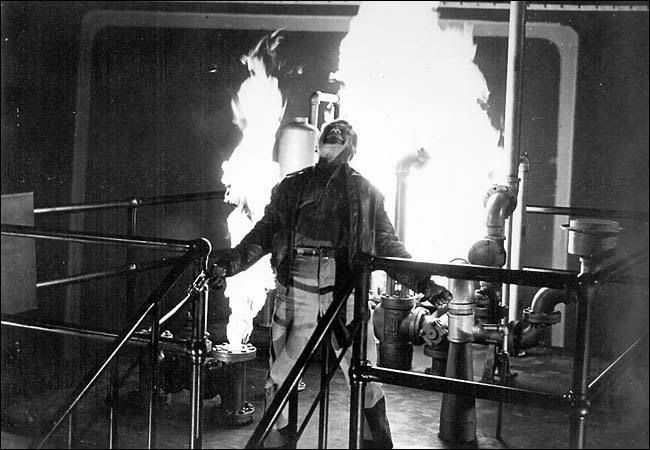
A few days ago, Terry came across a great clip from the Academy where individuals from the film industry named and discussed their favorite movie lines (you can watch it here). That got us to thinking: What are our personal favorite lines from movies? Everyone has their own criteria for ranking lines, but for us it really only boils down to one thing: Whether the line stuck with us or not. Here is a ranking of my favorite lines from movies, along with brief explanations of who said them and why I love them so much.
Honorable Mention
Dr. Strangelove (1964)
The line: “Mr. President, we must not allow a mineshaft gap!”
Said by: General “Buck” Turgidson (George C. Scott)
Annie Hall (1977)
The line: “I guess that’s the way I feel about relationships. You know, they’re totally irrational, crazy and absurd. But I guess we keep going through it because most of us need the eggs.”
Said by: Alvy Singer (Woody Allen)
A Fish Called Wanda (1988)
The line: “Don’t call me stupid!”
Said by: Otto (Kevin Kline)
Speed (1994)
The line: “Pop quiz, hot shot.”
Said by: Howard Payne (Dennis Hopper)
Kill Bill Vol. 2 (2004)
The line: “Bitch, you don’t have a future.”
Said by: The Bride (Uma Thurman)
The Top Ten
10. Terms
of Endearment (1983)
The
line: “You got me into this, so you’re gonna have to trust me about this one
thing: You need a lot of drinks.” “To break the ice?” “To kill the bug you have
up your ass.”
Said
by: Garrett Breedlove (played by Jack Nicholson)
This list kicks off with a line that is not the world’s most profound or memorable or clever or even that funny – at least, when you read it on paper. But watching Jack Nicholson deliver this line is nothing short of tremendous. I tend to think it’s the ultimate Jack Nicholson quote, demonstrating the essence of his onscreen persona. It’s rude, crass, shockingly vulgar, and wickedly funny. It’s a perfect setting for the line, too: At a highfalutin Houston bistro Nicholson has taken his next door neighbor Shirley MacLaine to, on a date which has been years in the making. The line belongs to Jack of course, but MacLaine is great here too: Look at the ostentatious outfit she is wearing, the blue eye shadow smeared on her face, and the pretentious batting of her eyelids when she informs Jack that she does not care for escorts who get drunk (in retrospect, it’s a softball set-up that every movie audience knows Jack is about to smack out of the park). The delivery here is also important; replace Jack with an Al Pacino or Nicolas Cage or Adam Sandler and the effect of the line is entirely different. Jack Nicholson is an actor who has always understood the power of restraint (albeit, perhaps more so earlier in his career). The key to this scene is that in actuality, Jack really likes Shirley MacLaine and wants her to free herself of her pompous pretension. The line reads as a startling insult, but its intelligent delivery by Nicholson renders it as fundamentally good-natured as it is unexpected.
9. Sideways
(2004)
The
line: “If anyone orders Merlot, I’m leaving. I am not drinking any fucking
Merlot!”
Said by: Miles Raymond (played by Paul Giamatti)
Said by: Miles Raymond (played by Paul Giamatti)
For
this list, I’ve tried to select quotes that go against conventional wisdom and
mass consensus (“I make him an offer he can’t refuse” is nowhere to be found
here), but sometimes a line is so beautiful and so catchy and so reflective of
the totality of a character, I must force myself to look past its
understandable popularity. In Sideways, Miles loves wine but has a
particular disdain for Merlot. He
doesn’t explain why he feels this way until a crucial passage at the middle of
the film (which occurs shortly after this scene), so for the first hour of Sideways, his hatred of all things
Merlot comes off as a curious tic-like amusement that reflects his utter
dysfunction and anxiety in all things social.
It’s even funnier when you watch the movie; for all his boneheaded ignorance
about wine, Jack at least knows one thing for certain – Miles hates Merlot, and
knows his explosive rage toward anyone inferior enough to suggest drinking
it. He also knows, like the audience,
that Miles is quirky and absurd, like the best kind of humorists. Robin Williams once said that comedy is a
kind of explosion that comes out of a deeper and darker side of anger. Miles is a dark and depressed individual who
is newly-divorced, works a thankless job, cannot get published, and indulges in
alcohol, the strongest depressant of all.
Drinking Merlot should be on a shortlist of things that wouldn’t bother the oenophile Miles, but
somehow, ironically, this absurd small detail is precisely the thing to set him
off and lead him “to the dark side.” Had
Miles been a viewer watching Sideways,
it would be the most enjoyable experience he’d have had in a long time.
8. This
is Spinal Tap (1984)
The line: “You can’t really dust for vomit.”
Said by: Nigel Tufnel (played by Michael McKean)
Yeah,
I have a lot of lines from comedies on this list, but somehow, movies like Schindler’s List and 12 Years a Slave aren’t particularly
rife with wicked one-liners. So be
it. Spinal
Tap, of course, is and there are so many lines to choose from that boiling
down the dialogue to one single moment is a virtually impossible task. Of course, “This one goes to eleven” is the
one everyone picks, so why not opt for what is at the very least a top-five Spinal Tap line, and one that typically
elicits the most amount of voracious laughter from audiences – that is, if
audiences even catch it. It’s one of
those buried lines that has “improvisation” written all over it, and many times
goes unheard because audiences are too busy laughing at the dialogue that
precedes it: A recalling of the tragic death of Tap’s second drummer, Eric
“Stumpy Joe” Childs, at the hands of choking on vomit not believed to be his
own. Indeed, Stumpy Joe’s death will
always be an unsolved mystery because, alas, you can’t really dust for
vomit. Just as Derek and Nigel explain later in the
film, there is such a fine line between stupid and clever, and Spinal Tap’s script dialogue
finds an uncanny balance between insights containing outright stupidity and
bizarre cleverness, albeit with frequently misplaced and confused logic. The real symphonic harmony of Tap comes not when the actors are
performing on stage, but when McKean, Guest and Shearer are riffing on each
other through unbroken stretches of seemingly unrehearsed and blithely honest
conversation.
7. Naked
Gun 33 1/3: The Final Insult (1994)
The line: “It looks like Phil Donahue is throwing up in a tuba.”
Said by: James Earl Jones (played by James Earl Jones).
Said by: James Earl Jones (played by James Earl Jones).
My
unfailing love of Naked Gun 33 1/3 oscillates
somewhere between indefensible and contrarian, but moments like these make it
unapologetic. Like many of the lines on
this list, it operates successfully on two levels: first, without any context
or background (because the idea of Phil Donahue throwing up into a tuba is
funny in its own right), and second, within the context of Naked Gun 33 1/3’s story events. The set-up: Lieutenant Frank Drebin (Leslie
Nielson) learns of a diabolical terrorist plot to blow up the Oscars. In order to find the trigger to the bomb
(which is located inside one of the award envelopes), Drebin disguises himself
as Phil Donahue, and abundant hilarity ensues.
But perhaps the funniest moment occurs after the girlfriend of the head
mobster (played by Anna Nicole Smith) tries to thwart Drebin by seducing him
backstage, until it is revealed that she is – SHOCK! – a man (of course, this
joke was probably funnier when audiences could recall the cultural zeitgeist of The Crying Game, but no matter). Drebin’s response of disgust – itself unintentionally
funny in its outrageous lack of political correctness by 2015’s standards –
results in an ill-timed stomach discharge at the precise moment Mr. Jones and
Ms. Dukakis are about to present the award for Best Picture (and for those of
you counting on home, that’s the second line of dialogue on this list
pertaining to vomit. This list is
nothing if not scatological.) And
keeping in line with the Zuckers’ brand of rapid-fire comedy, immediately following
Jones’ subdued exclamation comes another comic gem by the film’s sendup of Gil
Cates: “Someone take a note. I don’t
think we should invite Phil Donahue back next year.”
6. Tootsie
(1982)
The line: “That is one nutty hospital.”
Said by: Jeff, the roommate (played by Bill Murray).
Said by: Jeff, the roommate (played by Bill Murray).
Bill
Murray has had so many great deadpan lines over the course of his career, and
this one never fails to crack me up. It
actually comes at the heels of an even funnier moment in Tootsie (who am I kidding, it might be the funniest moment in
cinematic history), when Dustin Hoffman reveals to a shocked medical staff at
Southwest General that he is not the outspoken hospital administrator Dr. Emily
Kimberly, but “Edward Kimberly, the reckless brother of my sister Emily” (and
he is “not deranged!”) The reaction of
the medical staff, the actors who play them, the TV crew at the soundboard, and
audiences across the country is the same: Genuine shock, horror, and
disbelief. Actually, that’s only
partially true. The reaction is all the same except for in one place: Michael
Dorsey’s apartment, where his roommate Jeff (a brilliantly understated Murray)
is halfheartedly reading a Dashell Hammett novel and exclaims, in the wry way only Bill Murray could master, that Southwest
General “is one nutty hospital.”
Perfect. Acting is such a crucial
part of what makes these lines memorable, and Murray’s subtle body movements
(wagging his finger, shaking his head, the hint of a smirk) make this line a
perfect coda in a movie that is always self-consciously aware how ridiculous
its story really is.
5. Apollo 13 (1995)
The line: “We’ve never lost an American in space, we’re sure as hell not going to lose one on my watch. Failure is not an option.”
Said by: Gene Krantz (played by Ed Harris)
In
actuality, “Houston, we have a problem” is a rather empty line, void of any
real meaning, substance, or eloquence.
It’s essentially the glorified way Tom Hanks exclaims “Oh shit!” after
the first main bus undervolt goes haywire.
So if we’re really scavenging Apollo
13 for its most memorable and erudite sentences, we need look no further
than Ed Harris’ character, NASA flight director Gene Krantz. Krantz has several zingers that do a great
job of putting the potential of mass disaster in a broader perspective, while
espousing the need for an optimistic outlook when all hope looks lost (“With
all due respect, sir, I believe this will be our finest hour.” “I don’t care
about what anything was designed to
do, I care about what it can do.”
“Let’s work the problem, people. Let’s not make things worse by
guessing.”) But it is this line that
most effectively sums up Krantz’s philosophy and outright purpose at mission
control (while serving as the convenient coopting of his image for larger mass consumption). Specifically, I like two things about this
line. First, Krantz is not-so-subtly
watching out for his back by making sure he avoids any blame at the future day
of reckoning. And secondly, if you
really think about the line, it’s seems somewhat redundant. I mean, do the eggheads at mission control,
in the midst of sleepless work schedules and sweat-filled moments of haphazard
and improvisational patchwork, really need to be reminded that failure is not
an option? They may not need the
reminder, but we as an audience do. The
beauty of Apollo 13 is watching how
countless individuals, from the spacecraft’s designers to the NASA pilots to medical
staff to the engineers to CAPCOM (and
even to “the guys sweeping sweeping the floor,” as Lovell says early in the
film) are firmly committed to getting Lovell, Haise, and Swigert back safely to
home. It’s simple and extremely
honorable. Failure is not an option for
anyone.
4. Casablanca (1942)
The line: “Round up the usual suspects.”
Said by: Captain Louis Renault (played by Claude Rains)
Said by: Captain Louis Renault (played by Claude Rains)
There
are more well-known lines (“Here’s looking at you kid;” “Play it, Sam.”) There are more evocative and richly worded
lines (“Of all the gin joints in all the towns in all the world . . .” “The problems of three people don’t amount to
a hill of beans in this crazy world.”)
There are more ironic lines (“I think this is the beginning of a
beautiful friendship). And certainly
funnier lines (“I’m shocked – SHOCKED – to find that gambling is going on
here!”) But the usual suspects line has
always been my favorite; not so much because of what is spoken in the line, but
what is unspoken. After Major Strasser
has been shot by Rick, Captain Renault is faced with a major decision: Whether
to arrest Rick and conform to Vichy’s Nazi apologists, or tacitly stand up to
the Nazis by turning the other cheek. By
opting to round up the usual suspects – code word for “Nothing happened here!”
– Renault enables Casablanca’s amoral code of justice (or lack thereof) to
serve as a victory for Rick, Ilsa, and the rest of the Allied Powers. Renault’s line could have been something
bland and simplistic like “Major Strasser deserved to get shot” or “Let’s head
back home.” But this eloquent dialogue
serves as a symbolic refrain throughout Casablanca
– that corruption almost certainly corrupts, but also (as Renault significantly
informs Strasser earlier in the film) “blows with the wind” and of course by
the end of the film, we know from what side of the ideological vortex the
prevailing wind is blowing. It’s saying exactly what we need to know, but
without saying it.
3. Jackie
Brown (1997)

The
line: “You can’t trust Melanie. But you can trust Melanie to be Melanie.”
Said
by: Ordell Robbie (played by Samuel L. Jackson)
A
line that probably no one remembers, is uttered in such passing reference that
you might miss it, and really doesn’t have much to do with the main events of
the film. It’s so overlooked, in fact,
that I can’t even find a sufficient YouTube clip of the scene it is in. But no matter – someone needs to talk about how great this line is. Like I said, the actual circumstances behind
this line aren’t particularly important; Ordell (Samuel L. Jackson) has just
discovered that his girlfriend l'il beach girl Melanie (Bridget Fonda) tried to
enlist his former cellmate Louis (Robert De Niro) to scheme Ordell out of his
money. After busting Louis’s balls for
having sex with the woman he assumed to be Ordell’s girlfriend (“I hope you felt
appropriately guilty afterwards!”), Ordell’s response to Melanie’s wily
treachery is not surprise or even anger, but resignation that, alas, some
people behave in exactly the ways we expect them to behave. You can’t trust them, dammit, but you can trust
them to be them. This line actually reveals less about Melanie
than it does about Louis – that he’s more loyal to Ordell than Melanie suspects
– and Ordell – that he knows this about Louis and he knows Melanie’s true
agenda behind seducing Louis. Hell, he
even sort of respects her for it. Why
not, it’s not as though he’s exactly morally pure either. The line may be about Ordell’s relationship
with Melanie within the confines of the quirky Tarantino cinematic universe,
but quietly, it’s about all of human nature.
2. Ocean’s
Eleven
(2001)
The line: “Does he make you laugh?” “He doesn’t make me cry.”
Said by: Danny Ocean (played by George Clooney) and Tess Ocean (played by Julia Roberts)
Said by: Danny Ocean (played by George Clooney) and Tess Ocean (played by Julia Roberts)
#2
may sound high, but let me explain. Here’s
an example of a line that cuts across like a dagger to the heart. In this particular scene, Tess (Julia
Roberts) is explaining to her former beau Danny Ocean (George Clooney) why she
left him for the emotionally cold casino baron Terry Benedict (Andy
Garcia). But in reality, this exchange
is as much about Danny and Tess as it is Rick and Ilsa or Jack Dawson and Rose
DeWitt Bukater or Rhett and Scarlett. In
only ten brief words, the entire history of motion picture romances – and in
particular, love triangles and forbidden passions – is thoroughly expounded. You don’t need any flashbacks, any
reminiscing, any sex scenes, or any cheesy romantic montages to explain the
power of Danny and Tess’s attraction.
You also don’t need anything more to demonstrate the helpless inadequacy
of Terry Benedict as a replacement for Danny.
And it is at this point of the movie where you know, without any doubt,
that these two characters must end up with each other by the end of the movie,
because as everyone who watches movies knows, the only sin greater than being
with someone who can’t make you laugh is being with someone so distant that
they can’t even make you cry. Just ask this guy. Of course, it is extremely helpful having
actors as elegant, beautiful, and iconic as George Clooney and Julia Roberts
recite this dialogue. But like many
lines on this list, all it takes is simply a few brief, fleeting words to
explain everything.
1. My
Dinner With Andre (1981) / Autumn
Sonata (1978)
The line: “I could always live in my art, but never in my life.”
Said
by: Wally (played by Wallace Shawn).
My
all-time favorite line from a movie has two unique qualities going for it. For starters, it comes from not one, but two
different movies. And secondly, I must
confess that I have never actually seen Autumn
Sonata, the movie by the Bergmans (Ingmar and Ingrid) from which it
initially arises. My knowledge of the
line purely comes from my many viewings of My
Dinner With Andre, a movie obsessed with words and phrases and the
startling ideas that are sometimes contained inside and conjured by them. The line comes early in the film, when Wally
(Shawn) is explaining to the audience his uncertainty toward meeting his old
friend Andre (Gregory) for dinner. You
see, Andre was once a promising up-and-coming theater director and close friend
of Wally’s, but in recent years, had begun behaving in erratic ways, such as
traveling to remote places and talking to trees. “Obviously, something terrible had happened
Andre,” Wally explains. But the straw that breaks the camel’s back comes one
night when a mutual friend of theirs witnesses Andre on a street corner in a
strange part of town “seized by a fit of ungovernable crying” while repeating
the aforementioned line from Autumn
Sonata.
OK,
OK, sounds a bit hysterical, I realize.
But the line reinforces the central question of My Dinner With Andre: How are artists supposed to function in a
“real” world where they are left without the tools to create their art? What happens when the painter loses his
brush, or when the sculptor loses uses of his hands? Perhaps it isn’t even this extreme; maybe the
question is more how anyone with a passion is able to successfully find
balance. For most of us, the two
weightiest compartments of life which struggle to coexist are “work” and
“family,” which Wally and Andre spend a good amount of time discussing. But artists have an additional impulse to
fulfill: Creativity, something which often demands more time, attention, and
money spent away from those other aspects of life, leading to dysfunction,
abuse, and bitterness.
This
line strikes me as particularly resonant for people who love movies because when
life presents you with difficult or demanding circumstances, it is so tempting
to simply tune everything else out by turning on a movie. Movies illustrate complex problems too, but
they also show crafty and commendable way those problems are battled and
conquered. Life is not so
convenient. For artists – or anyone with
a passion – life’s problems are dealt with indirectly and tragically, through
channeling fiery emotions on to a blank canvass rather than the individuals or
circumstances that are actually the root cause of the dysfunction. Vincent Van Gogh cut his ear off. William S. Burroughs injected heroin. Hemingway, Fitzgerald, and countless others drank. It’s so much easier to live in your art rather
than in your life. But My Dinner With Andre (and maybe Autumn Sonata, I’m not entirely sure)
warn us of the dangers of indulging too much in that temptation.
Thoughts? Disagreements? Any lines left unfairly overlooked? Write in the comments section below!