
Like the main character of my
favorite film of this year, I became homesick for motion pictures in 2015. In spite of the wealth of publications and
breathless critics proclaiming the usurping
of film by television (a claim that has been made on a regular basis since the
1940s), I still ardently believe, or am just too rigid to concede otherwise,
that even the most pedestrian movies are still better than the best TV
shows. Yes, film may be a dying art
(metaphorically as well as literally)
and television may be in a “golden age” – whatever that means – but no television
set, no matter how high-definition, can adequately replace the overwhelming
totality of the theatergoing experience.
And for those who vigorously assert that a 13-episode season contains
infinitely more complex narrative depth than even the most intricately written
two-hour film, I would counter that most often in drama as in life (as well as
with talkative guests at parties), less is more.
Television remained a vast wasteland
in 2015 (even in spite of a handful of watchable and engaging programs like Fargo, Better Call Saul and The Jinx),
and while it is undeniable that many movies in 2015 might have been a wasteland
too, at least their shorter running times enabled their experiences to be considerably
less vast. Of course, the most
successful movies in 2015 were fundamentally derivative – sequels, franchises,
remakes, rip-offs, or in some cases, all of the above – but let the populist audiences eat
their cake. At least films like Mad Max: Fury Road, Creed and Star Wars: The
Force Awakens added much-needed diversity, youth, and an astute sense of political
consciousness to their narratives rather than simply playing lazy old hat.
As for The Force Awakens, a film that outgrossed
all six of its previous installments in the first week of its theatrical
release: Say what you will about it (I personally enjoyed it more than I had
ever expected to), but few can deny the powerful pull it had for young and old
audiences alike, illustrating for better or for worse that commercial cinema
still has that unique and inimitable ability to bring even the most disparate
and dissimilar audiences together for the same cause. Even the snarky cynical Marxist in me can
take comfort in knowing that, in most cases, for a film to earn that much money
(much of which derives from repeat viewings), it has to have some markers of
quality. Same with Jurassic World, Furious 7 and
Spectre. No one went to those movies
because they were bad – people didn’t go to (or back to) Pan precisely because it was bad. And the millions of Chinese audiences who saw Avengers: Age of Ultron and Hunger Games: Mockingjay Part II had no other choice. It is wrong to blame movie audiences for all
the bad movies released and the gradual erosion of taste and critical insight into
media and storytelling. People are usually
smart, and great movies are genius. Instead,
let’s blame television.
2015 by the numbers
Total 2015 films seen: 61
“Thumbs up” percentage: 63.9 percent
Movies I haven’t seen that could still potentially
make this list: The Revenant, Son of Saul, The Lobster, Anomalisa, Mustang, Eden, 45 Years, Taxi, Jauja.
Movies I’m proud to say I didn’t see: Cinderella, The
Good Dinosaur, The Intern, Pixels, Fantastic Four, The Age of
Adaline.
Overrated: Room, Me
and Earl and the Dying Girl (two of the year’s worst movies), What We Do In the Shadows, Bridge of Spies, Love and Mercy, Time Out of
Mind, The Big Short, The Martian (It’s probably appropriately
rated, but nowhere near deserving of Best Picture).
Underrated: The Walk, Dope,
Unfriended, Boulevard, Paper Towns
(not good, but so much better than Me and
Earl…), Blackhat, the first 20
minutes of Fifty Shades of Grey, and
yes, Star Wars: The Force Awakens (That’s
for all the haters.)
Best Actor: Jason Segel, The End of the Tour
Best Actress: Saoirse Ronan, Brooklyn
Best Supporting Actor: Liev Schreiber, Spotlight
Best Supporting Actress: Alicia Vikander,
Ex Machina
Honorable Mention

Carol (Todd Haynes)

Inside Out (Pete Docter)

It Follows (David Robert Mitchell)

Mad Max: Fury Road (George Miller)
Sicario (Denis Villeneuve)
The Top Ten

10.
The Hateful Eight (Quentin Tarantino)
If it feels obligatory putting another Tarantino film in my top ten list for
the year, it is because his films represent the best aspects of motion pictures
in general. He is a visionary auteur who
self-consciously invokes his cinephilia both on-and-off the screen. His films are uncompromising, lengthy, full
of circular and quirky inimitable characters and dialogue, and full of images
that are as violent as they are inherently, romantically cinematic. The
Hateful Eight is chalk full of Tarantino, from the setting (a
self-reflexive western) to the actors (Samuel L. Jackson, Michael Madsen, and
Tim Roth, among others) to the over-the-top levels of bloodshed in the film’s
second half. But even in spite of those
recognizable components, the film still feels fresh and engaging, portraying
characters we want to know more about, events that have greater significance
than what we could possibly initially comprehend, and outrageous moments that
no other director would have the audacity to remotely approach. In interviews, Tarantino has discussed how, in
spite of being confided to a single interior space over a single 24-hour
period, the story of The Hateful Eight is
really the story of reconciliation after the Civil War between the North and
the South. This reconciliation is
anything but seamless and, as Tarantino’s recent activism
has demonstrated, neither has it been fully resolved in 2015. But the way it is depicted in The Hateful Eight – through a surprising
degree of delicacy and thoughtfulness in the midst of vast bloodshed and
dismembered body parts – is as idiosyncratic and improbable as its virtuosic
filmmaker.

9.
Tangerine (Sean Baker) One of those
wonderful and woefully rare movies where, after the first ten minutes, it is
safe to say you have no idea what you have gotten yourself into. As I wrote in my initial full-length review,
the story is something of a cross between Paul Haggis’ Crash and The Jerry Springer
Show: Two transgendered hookers (Mya Taylor and Kitana Kiki Rodriguez)
spend 24 hours before Christmas hanging out in a donut shop, confronting a
cheating ex-boyfriend, performing music at a local bar, soliciting johns on
Hollywood Boulevard, and enacting revenge on an adulteress. The movie is simultaneously funny, vulgar,
sweet, gritty, trashy, and even surprisingly touching. It is also somewhat groundbreaking; director
Baker shot the entire film on an iPhone 5s using nothing more than an
anamorphic adapter blow up the images.
The result is a crisp, detailed production that looks in no way as
though it was filmed using a consumer device.
The film is by no means a “message” picture, but it is difficult to
believe that even the most skeptical and socially rigid audience member would
not be won over by the charming and diverse cast. Ultimately, Tangerine is not about sex as much as it is about being an
outsider, and how vital it is to combat the loneliness and isolation that comes
with the territory of not belonging, with other people you can put your trust
in. Of course, the film is much too fun
and subversive to be caught up with anything approximating that preachy of a
message, but deep down, Tangerine has
its heart firmly in the right place.

8.
Goodnight Mommy (Veronika Franz and
Severin Fiala) After you see it, you will probably observe its narrative
resemblance to certain other films and novels (which I dare not mention here),
but for the most part, Goodnight Mommy is
not concerned with plot – the film’s overwhelming concern is mood and
atmosphere. The story is told through
the perspective of twin cherubic 10-year-old boys, Elias and Lukas (played by real-life
brothers Elias and Lukas Schwarz), who inhabit an isolated house deep in the
woods. One day, a woman purporting to be
their mother returns with bandages wrapped around her face after having
undergone substantial facial reconstructive surgery (the first of two films on
my list this year to involve a woman whose facial surgery brings her identity
into question). The boys quickly realize
that the woman is not who she claims she is and they begin to craft ways of
bringing their real mother back – the results of which become gradually more
dark and twisted. The film moves at a
slow pace in the first half, only to move to a much more ominous, quick, and
violent resolution in the second half; this strategy reveals itself as
intentional at a certain point when revelations are revealed which call into
question the reliability of some of the characters. Like the best films of Michael Haneke and
Lars von Trier, Goodnight Mommy contains
a deep and unremittingly dark view of humanity, which in many respects is far
more disturbing than any bloodshed depicted in the film. It is the type of film that could never be
made in the United States (or rather, if it was made, it would be more chopped
up than Elias and Lukas’ mother’s face), and yet somehow after seeing it, your
first impulse is to watch it again.

7.
The Walk (Robert Zemeckis) At this
point, it is more than fair to call The
Walk a box-office bomb (grossing only $10 million domestically, less money
than The 33, Burnt, and The Gunman). It has also been all but completely ignored
by critics and end-of-year awards, which is rather inexplicable for a major
studio film released in October to favorable reviews. Maybe it was the PG rating,
maybe it was Joseph Gordon-Levitt’s French accent (not bad at all in fact), or
maybe everyone thought they already knew all about Phillippe Pettit’s
incredible tightrope walk across the Twin Towers in 1974 after seeing the 2008
documentary Man on Wire. Who knows.
In any event, Zemeckis’ film is a spectacular rendering of Pettit’s
unconventional journey, first as a fearless street performer and amateur
tightrope walker in Paris, then as an internationally-renown daredevil putting
his life in danger for the sake of his art.
The story is a neat combination of Ocean’s
Eleven and Hugo, and the
supporting characters are interesting and serviceable, but the heart of The Walk is its incredible visual
effects, which are truly heart-pounding and even stomach-inducing. I must admit without hyperbole, my palms
became unspeakably sweaty for most of the film’s final hour. I suppose one must ask the same question that
was asked of Avatar and Gravity, which is whether the IMAX 3D
experience put a spectacular disguise on an otherwise pedestrian story. But in this era where film and TV spectatorship
has become disturbingly intertwined, The
Walk serves a reminder that there is no other experience quite like an epic
movie (on a movie theater screen) transporting you to a visual world few others
have ever seen.

6.
The Lesson (Kristina Grozeva and Petar
Valchanov) This was an excellent under-the-radar film from Bulgaria that no one saw
because it only played in a handful of festivals at U.S. cities (fortunately,
it is available to stream right now on Netflix). The story: An English teacher named Nadya (Margita
Gosheva) is on the verge of bankruptcy, cohabiting with an insolvent
alcoholic husband and a young daughter.
The film profiles a few days in her life, as creditors are able to track
her down and threaten to foreclose on her house unless she can come up with a
substantial sum of money. Aesthetically
and narratively, the film bears an unmistakable similarity to Two Days, One Night, as Nadya scrambles
desperately to solicit assistance from friends and family (as well as the
occasional perfect stranger), all while steadfastly struggling to maintain her
dignity in the face of surrendering to defeat and humiliation. It’s not as good as the Dardenne Brothers’
masterpiece, but I enjoyed the way the film goes to great lengths to establish
an elaborate geographical and emotional universe (albeit on a small scale) that
seems to throw hurdle after hurdle at the likeable and engaging heroine. The film moves at a very quick pace, is often
quite unpredictable, and even contains a few scenes of wicked and unexpected
humor (such as Nadya’s confrontation with her estranged father’s new trophy
wife). And Gosheva’s performance is one
of the year’s best, illustrating the stark realities of a desperate teacher
trying haplessly to honor the same ethical code she so rigidly instills to her
students.
5.
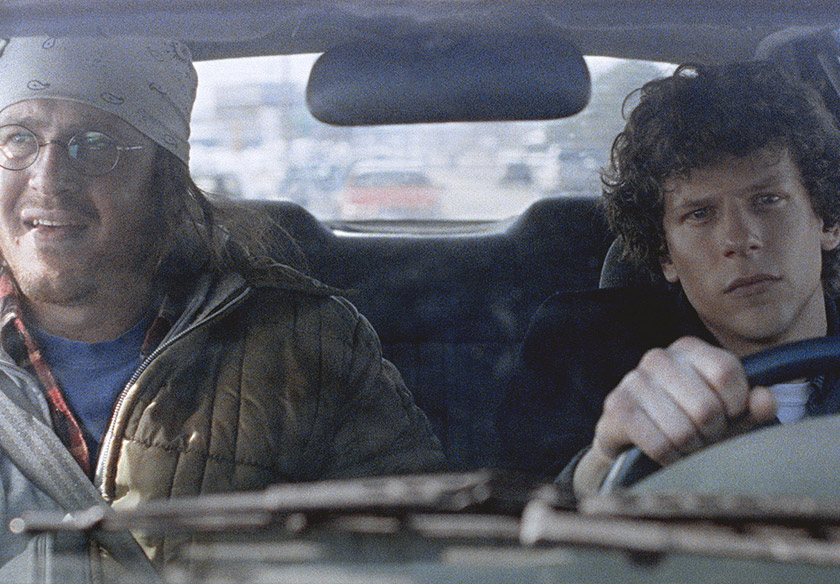
The End of the Tour (James Ponsoldt)
From a purely subjective standpoint, there may have been no film more
personally enjoyable to watch in 2015 than The
End of the Tour, particularly in light of the considerable doubts I had
walking into it. Would the film lionize,
demystify, or lampoon David Foster Wallace and his mythical literary status
over the past two decades? Would
Ponsoldt dumb down Wallace’s complex and uncompromising personality, and how
would his intellectual contributions be translated into a coherent
narrative? For all its audacity, the
film finds its greatest success in how small it is, opting only to show a few
days in Wallace’s life soon after the publication of Infinite Jest in 1996. Not
too far removed from Almost Famous,
the film depicts a struggling young Rolling
Stone writer named David Lipsky (Jesse Eisenberg) given unprecedented
access to Wallace (Jason Segel) at the precipice of his launch into
international stardom. The vast majority
of The End of the Tour is the long,
rambling, often unresolved conversations between the two protagonists, which
recalls the rich and beautifully unkempt attitudes of 1970s cinema
(particularly Wim Wenders
and Eric Rohmer). Set against a backdrop
of the snowy Midwest, Wallace is depicted as a relentlessly self-conscious and
earnest burgeoning intellectual, and the film is daring in the way it doesn’t
shy away from frequent unspoken tension and hostility between him and
Lipsky. Both performances are
outstanding, but Segel in particular ascends to completely new levels of
acting, using a beautifully understated demeanor to hint at deep levels of
despair and loneliness. In spite of
everything you may think you know about Wallace – and everything you think you
know about Wallace’s acolytes and imitators – the film shows something new with
dialogue that feels substantive and meaningful, which has become rare for the
majority of commercial cinema.

4.
Spotlight (Tom McCarthy) The current front-runner
for Best Picture is well-deserving of the praise which has been bestowed on
it. It is a story that could have easily
gotten swept up in the hysteria and revelations of the Catholic Church’s sex
abuse scandal, as exposed by the Boston
Globe’s Spotlight investigative reporting team in the early 2000s, but
rather than being exploitative or overly political, the film wisely limits its
purview solely to the perspectives of the journalists working on behalf of
Spotlight. Subsequently, the film isn’t
really as much about the church abuse scandal as it is the contours and nuances
of investigative journalism in the era just before the internet made access
instantaneous and near-universal (and arguably rendering much previous investigative
journalism benign and reactionary). Like
All the President’s Men, the film is
singular in its focus on reconstructing events that occurred years earlier by
characters we’re vaguely familiar with through name and verbal description
only. Even by the end of the film, we
know considerably more about the much-ballyhooed classified church documents
than we do about the personal lives of the reporters (played with uniformly
strength by Michael Keaton, Mark Ruffalo, Rachel McAdams, and Brian d’Arcy
James), which is precisely the point. It
would be a fallacy to praise the film on that one aspect alone, but it deserves
recognition because McCarthy’s focus (as one of the film’s characters astutely
points out) is not on the relatively inconsequential individuals involved, but
the larger institutional systems that enabled and promoted years of abuse and
cover-up. The film also illuminates the
power of ethical, painstakingly-researched journalism in a way that isn’t quite
Frank Capra, but also isn’t cynical or jaded either. Spotlight
is quietly a David-and-Goliath story where the slingshot is replaced by the
much more powerful mighty pen.

3.
Ex Machina (Alex Garland) You may
have heard that Ex Machina contains
the best dance scene in recent cinematic memory (you would be correct). It also is the best pure sci-fi film in an
era when the notion of “sci-fi” has been relegated to mean bloated budgets,
high-octane action with little attention to story, and superfluous special
effects replacing intellectually probing questions about the future of human
ingenuity. In yet another remarkable
performance in a truly prosing career, Oscar Isaac plays a somewhat-mad scientist
named Nathan who invites a young protégé named Caleb (Domhnall Gleeson) to
participate in a Turing test at his remote laboratory in order to prove that
his artificially intelligent fembot, Ava (Alicia Vikander), could pass for
human. Structurally, the film is
essentially a cat-and-mouse game between Caleb and Nathan, with each one
suspicious of the other’s motives and as a result, eager to make the next move
before the other catches on. All the
while, Ava proves to be more truly more intelligent than either man suspects
(the film has a nice undercurrent of feminism laced throughout), and eventually
the battle of wits over who truly controls Ava transforms into a larger
metaphor about what core elements remain uniquely human in a future when the
vast majority of intelligence has become robotic. Sure, it doesn’t boast the spectacular visual
effects of Interstellar or The Martian, but it more than
compensates through a story that is rich with intelligent, captivating dialogue
about the ethics of engineering artificial life, as well as dramatic events
that are truly surprising and unexpected in a genre whose tropes have often
become instantly recognizable and predictable.
The claustrophobic atmosphere (one remote house, four characters) gives
the film a feeling of immediacy and unease, while Garland’s camera and stark
color scheme invite the viewer into a universe where human emotions are
simultaneously nothing as well as the only thing.

2.
Phoenix (Christian Petzold) If The End of the Tour recalled Winders,
then Phoenix undoubtedly invoked
Rainer Fassbinder, full of melodramatic and absurd artifice in order succinctly
depict a scathing critique of society and historical memory. Taking place shortly after the end of World
War II, the film depicts a Holocaust survivor named Nelly (Nina Hoss), whose
face has been severely burned and deformed to the extent that she has been
rendered unrecognizable – even to her husband, who survives the war and
believes that she has died on the concentration camps. So there’s the Victor/Victoria conceit – Nelly
pretending to be someone pretending to be herself – but that is only the first
and most basic level of plot; the film really is much more concerned with
asking the question what it means to be a Jewish Holocaust survivor in a world
where there are no more Jews or Holocaust survivors, but only those who consented
to sacrifice their ethics and loyalties in exchange for an empty life under the
Third Reich. Nelly becomes a disembodied
observer of herself and the people she used to know before her fate was sealed
in the camps, and in that sense, she represents survivors of the Holocaust who
attempt to return to their lives only to realize that returning to their lives
before the war is impossible. Petzold’s
film is imperfect and complex, so complex in fact that it is difficult to
follow at times, but the result is a film that is so overwhelming and
narratively rich that it left me aghast for days after initially viewing
it. Who are these people and why are
their motivations shaped in the disorienting and perplexing ways that they
are? An American film would have undoubtedly
attempted to answer these questions in broad, obvious strokes, but Phoenix remains mysterious and
beguiling. The brilliant final scene
shows Nelly finally saying everything she needs to say to her husband but none
of it is expressed through words, instead only a fleeting and stunning
accidental glance.

1. Brooklyn (John Crowley) Even
in the weeks after seeing Brooklyn
and, at this very moment, considering the high quality of the other films on
this list, it still comes as a relative shock to me just how good Brooklyn truly is. It lacks the complex, rich narrative of Phoenix, the witty, erudite dialogue of The End of the Tour and The Hateful Eight, and the impressive
visual spectacle of The Walk. But as Roger Ebert famously decreed in his
first law of film, a movie is not what it is about, but how it is about
it. And no other film in 2015 understood
its subject matter better, nor more successfully enraptured its audience, than
Crowley’s adaptation of Colm Toibin's novel of the same name. In what was by far the best performance I saw all year, Saoirse Ronan starred as Eilis, an Irish girl in 1952 who makes the brave and tumultuous journey from her small hometown in Ireland to Brooklyn. Eilis is not exactly borne of an adventurous spirit, but rather is a shy, introverted, deeply frightened teenager on the brink of womanhood whose prospects for success as an immigrant in New York City are at first extremely poor. But after making a new family of the friends and acquaintances she meets at the boardinghouse she resides at, as well as getting a job at a department store, Eilis gradually learns to overcome the hardships of homesickness. This doesn't exactly sound like groundbreaking material, but the way in which this story is told -- through careful and delicate observations, as well as handsome period detail throughout -- quickly makes Brooklyn's story captivating, even as we anticipate the film growing stale and sentimental with the emergence of a love interest and inevitable trip back home to Ireland. In actuality, the film gets better and edgier as it goes along. Eilis' return visit shows that in spite of her growth and blossoming into independence and adulthood, like the best of us she still succumbs to the nostalgic scent of home, even with the idea of home is fraught with complacency, stunted dependence, and limitations abound. The final image of Brooklyn is that most cherished of all cinematic images -- a kiss -- except of course it signifies so much more than simply a kiss; for Eilis, it is the embrace of freedom and endless possibilities. It's only on the surface that Brooklyn is a movie about America. In reality, Brookyln is about the romance of finally growing up and becoming a citizen of the world.
Thoughts? Disagreements? Let me know below!


